Līga and Uģis Zemturis grow mushrooms in their office and then sell them both fresh and processed as a source of vitamins. Right there you can also enjoy a nine-course dinner paired with wines selected by Raimonds Tomsons.
What do a financier and a model have in common? Mushrooms, of course!
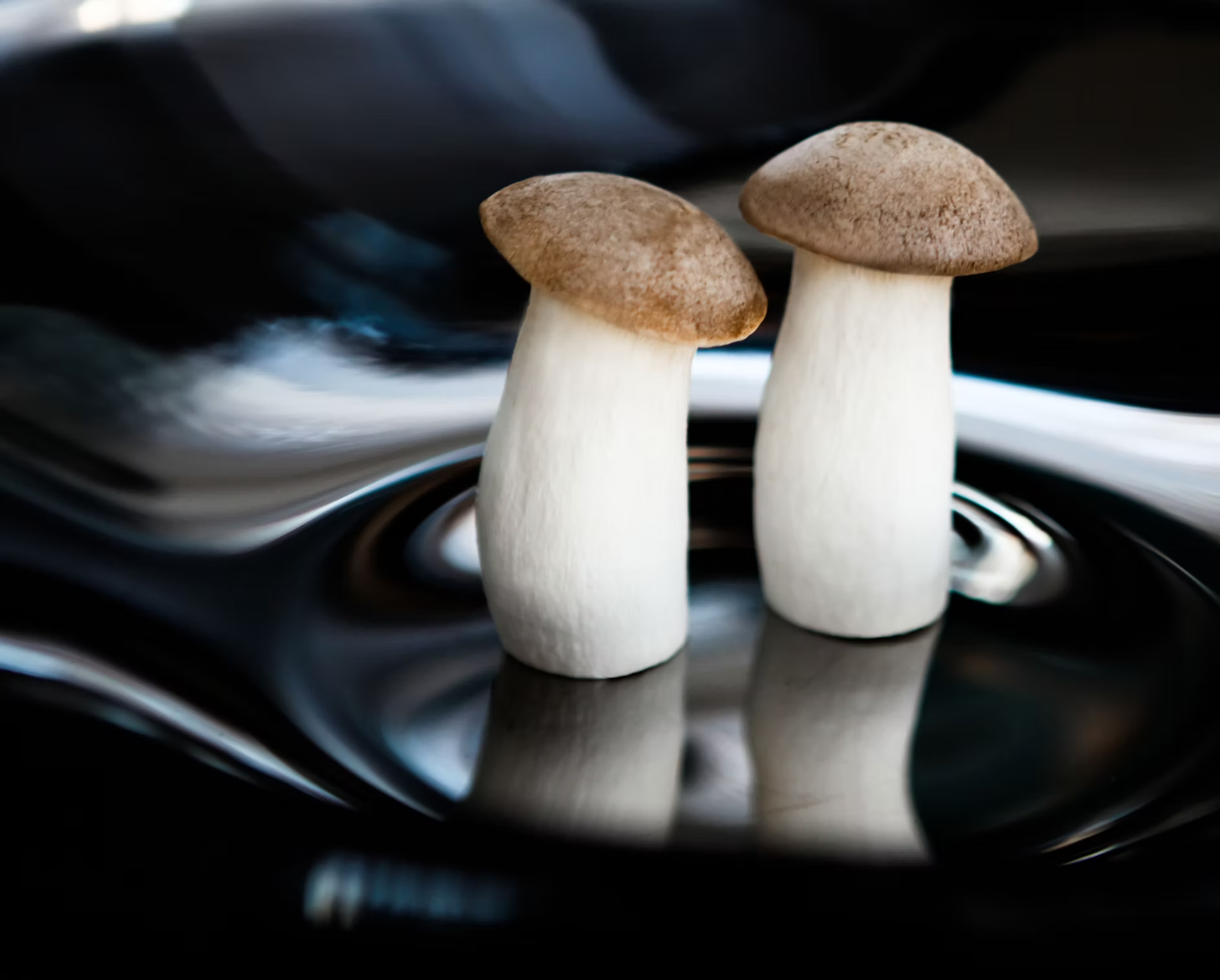
Fashion industry professional Līga Zemture and financier Uģis Zemturis are building a joint business – they grow Japanese Eringi mushrooms and later sell them fresh, marinated, or processed. Even though the product range is not large in number, it is still impressive – for example, mushroom cocoa and dietary supplements in capsules. While it is still difficult to call the company a business, the potential is huge – in hospitality, pharmaceuticals, and design alike.

Judging by what can be seen on site, in this project Līga and Uģis have been doing everything right from day one: first they learn and research, then they experiment, implement the circular idea in practice, and experiment again, thus arriving straight at excellent products instead of improving something over time. Now the task is to sell this success story.
The idea for the Japanese royal porcini brand and business was born during a trip to the homeland of these mushrooms, Japan, where they developed a taste for them – so much so that they wanted to eat them more often.
Uģis Zemturis has spent several years self-studying mushrooms, involving Latvian scientists from the University of Latvia and the Latvia University of Life Sciences and Technologies for the cultivation and processing technology. Part of the funding has come from their own resources, and part – with the support of the Investment and Development Agency of Latvia (LIAA). The company is also in the LIAA incubator, while the mushrooms themselves grow in a relatively small space right at the company premises, so to speak – in an office in the center of Riga. The office is not quite an office – it is a spacious former brewery building that Līga and Uģis have restored themselves. Now it is a representative space where, by reserving in advance, you can also taste the mushrooms in a nine-course dinner paired with wines selected by world sommelier champion Raimonds Tomsons.
Although the company is still small, it is an excellent example of the circular economy: the mushrooms are grown on bran residues and wood shavings, and after they have grown and taken the necessary substances from this “soil”, the remaining substrate is used, in cooperation with scientists from the Latvian State Institute of Wood Chemistry, to create a biocomposite material. It is a pressed substrate used to make packaging that holds a beautiful crystal container, which in turn contains the mushroom dietary supplement – a source of vitamin D.
Even though, when talking to the two entrepreneurs, everything seems to blend into one hard-to-grasp project where all sorts of things are happening, in reality the activity has been structured from the very beginning – as befits a banker. The startup currently has two brands: Imperia Organic, which is the main brand as well as the company’s legal name, and the “daughter” brand MUSH DNA, used specifically for food products such as mushroom cocoa.
Imperia Organic aims for sales in world metropolises – London, Los Angeles, Dubai and elsewhere – where there are more millionaires, meaning an audience that matches the product prices. For example, mushroom cocoa costs 170 euros, and dietary supplements in crystal packaging – 1000 euros. The most expensive part here is the packaging, because a monthly dose of the dietary supplement can be refilled for 200–300 euros. If you want to taste fresh or marinated mushrooms, you can buy them, for example, in a Stockmann store for around 20 euros. The taste and texture are somewhat reminiscent of a cross between scallops and our own forest porcini.
The passion and enthusiasm with which Uģis and Līga talk about their creation cannot be described in words, but in person it is clear – this project has been built out of interest and conviction, so it should succeed. In any case, if some of the experiments do not work out, the mushrooms can still be eaten – Uģis comes up with and tests the recipes himself. Their favorite way to eat the mushrooms is sautéed in butter until golden and crispy, with a hint of garlic and chili flakes.
Originally published at https://inc-baltics.com/senot-sava-biroja/

Like

Love

Happy

Haha

Sad