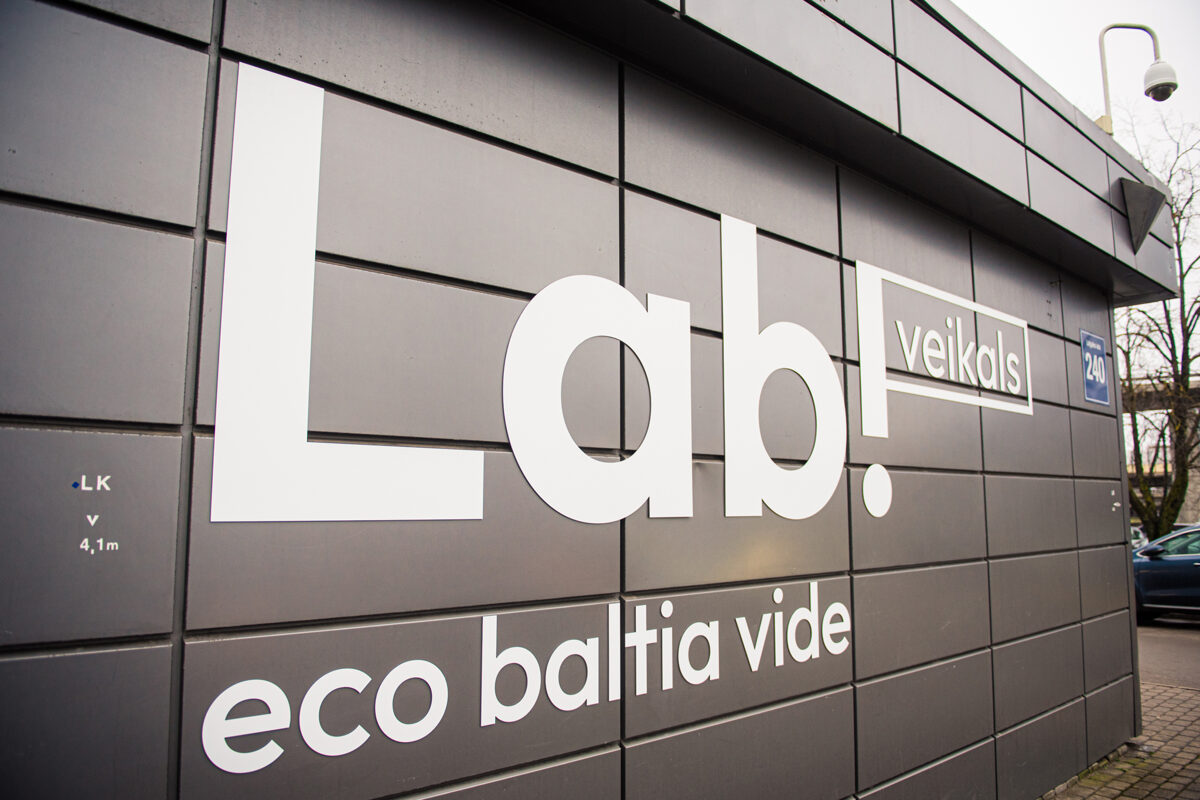
“Young people only talk about green lifestyles on social media; we don’t see them in our store,” says Eco Baltia Vide Chairman of the Board Jānis Aizbalts. At the beginning of the year, the company he heads opened the store “Lab!”, where you can buy electrical appliances discarded by previous owners, but repaired again by the company’s technicians. Worldwide, this is a business worth billions.
Aizbalts says that the store’s average customer is a man about 50 years old who still experienced Soviet times, understands the value of things, and realizes that a repaired device is no worse than a new one.
The company obtains repairable devices, many of which often hardly need repairing, from electrical collection points and special used-electronics bins in shopping centers. Looking at devices that were still in use, the company considered distributing them to its employees, because they couldn’t bring themselves to send these devices for recycling – breaking them down into components. “At a certain point it started to seem strange to us that we are obligated to send all electronics for recycling; we wanted to do something more meaningful,” says Aizbalts.
This is how the idea arose to set up a workshop and open a store. The State Environmental Service also confirmed that by acting in this way, the company will continue to fulfill its legally mandated obligation for the collection and recycling of electrical equipment.
To create the store and workshop, the company invested 80 thousand, and part of this amount was covered by the LIFE integrated project “Waste as Resources in Latvia – Promoting Regional Sustainability and Circularity by Implementing the Concept of Waste as a Resource”.
In addition to the fact that the younger generation does not want to use repaired items, the company’s employees have also found that manufacturers of electrical devices have done almost everything possible to make devices impossible to repair. “So that you come back for the next new device,” says Aizbalts, adding that the company has compiled statistics on manufacturers whose devices are made so that they cannot be repaired. The collected data are sent to European Union institutions that are preparing an initiative to oblige manufacturers to produce goods that can be repaired. Experience from “Lab!” shows that, for example, the most repairable washing machines are made by German manufacturers. Although they are more expensive, they can be repaired – unlike those made in Italy or Poland, for instance.

Eco Baltia Vide Chairman of the Board Jānis Aizbalts.
The largest group of repaired items (41%) are small devices and tools – mixers, hair dryers, electric saws. Hair dryers usually are not even broken, says Aizbalts; they just need the air filter cleaned. 37% of the repaired devices are computer mice, phones, tablets, and 10% are monitors or devices with a screen.
The company’s goal is not to make a profit. In the five months the store and workshop have existed, just under 1,000 devices have been returned to circulation. This has brought in 15 thousand euros and allowed three technicians to be employed. For now, the project is also supported by LIFE funding, but when opening stores in the regions as well, the company plans to operate at “break-even” even after the LIFE program ends.
The French company Back Market, which does exactly what “Lab!” does, operates on a completely different scale. The French company’s market value is estimated to be well over a billion. Aizbalts does not hide that, in setting up “Lab!”, the company he leads was in some ways inspired by Back Market, but did not set such ambitious goals. “Nothing like that is possible in Latvia, but in France, with almost 70 million inhabitants, it’s easy enough to find a few hundred thousand who appreciate a repaired device,” says Aizbalts.
Business is going so well for the French Back Market that they have expanded operations to the US and are beginning to accustom Americans to having their smartphones repaired. How did it start?
One morning in July last year, while feeding his then two-year-old daughter, Thibaud Hug de Larous, put his 2017 iPhone 8 Plus on the bed. A few seconds later, he heard a loud noise – his daughter had taken his phone, and there it was, lying at the foot of the stone staircase in his 19th‑century house, with a smashed casing and glass.
Many tech CEOs would most likely have simply ordered a new phone, but Hug de Larous thinks differently. As the co‑founder and CEO of Back Market, a retailer of refurbished devices and a well‑known French “unicorn”, he’s practically duty‑bound not to admit defeat unless Back Market’s lab technicians declare a device irreparable. This time that’s exactly what happened, and Hug de Larous ended up with a refurbished iPhone 12 Pro Max, manufactured in 2020.
Hug de Larous is convinced he’s right to prefer repaired, previously used tech: “It’s much better in terms of savings, safety, and the environment.” He is not against innovation as such—and he doesn’t want to take away your iPhone. But Hug de Larous is concerned about how quickly one device replaces another. Given the rising costs of new devices—for both the environment and your wallet—he asks: “How much is innovation really worth? And do you really need a new phone every time Apple releases a new model?”
Now the company operates in 17 countries and offers more than 200 categories of refurbished devices – from household appliances to game consoles, such as the Dyson Airwrap and the Sony PlayStation. The Paris‑based company’s goal is to change how you think about devices. Last year Back Market, which has more than 700 employees, announced that since its launch it has fulfilled 30 million orders. In 2023 (the most recent year for which data is available), Back Market orders were worth 2.157 billion euros, 32 percent more than the previous year. In 2022, the company raised an impressive 510 million dollars in venture capital, bringing the total to 1 billion dollars and its market value to 5.7 billion dollars.
As Hug de Larous says, no less important is that the company has prevented more than a million tons of carbon emissions from entering the atmosphere, helping to slow the world’s fastest‑growing waste stream – discarded electronics. And the US, with its citizens’ desire to buy the very latest products, tops the list of these polluters.
Al Gore knows a few things about this uncomfortable truth. The former US vice president invested in Back Market after Hug de Larous pitched him the opportunity over Zoom. Gore’s Generation Investment Management head of investments Lila Preston says Back Market’s mission is ambitious and data‑driven.
The question now is whether Back Market will be able to convince tech‑obsessed Americans to downgrade. Although the company entered the US market in 2018, it is still relatively unknown. Hug de Larous wants to change that—and not just because America is a huge market opportunity for this booming company.
The extraction of raw materials and the water use needed to produce new devices such as smartphones have a significant impact on the planet. Hug de Larous urges consumers to extend the life of their devices as much as possible, either by repairing, swapping, or reusing them—for example, using an old smartphone as a baby monitor or a TV remote. When a device can no longer be reused, repaired, sold, or refurbished, it should be recycled rather than thrown away, as so often happens in Africa.
Back Market’s ambitious goals are helped by the fact that Hug de Larous is a rather atypical tech CEO. Although he is the son, grandson, and nephew of entrepreneurs, in his youth it seemed that he had not inherited their entrepreneurial genes. “I was a bit lazy,” admits the 37‑year‑old co‑founder.
A study‑abroad program that took him to Toronto was the catalyst. In Canada, the 16‑year‑old Hug de Larous lived with a host family and had to adapt to very low winter temperatures (“I’m not friends with the cold,” he says), as well as a very un‑French attitude to high schoolers drinking alcohol.
“It builds adaptability,” Hug de Larous says of the experience. Business school took him to the marketplace integrator Neteven, where he worked as head of sales. The inspiration for Back Market came in 2014 at a device repair company in southwestern France, when Hug de Larous visited one of his clients. He had no particular interest in refurbished devices—his other clients sold wine and clothing—but as he watched technicians swap out phone screens in dust‑free rooms and then test the devices, he thought: “This is cool, but no one knows about you.” On eBay and Amazon, refurbished devices were grouped into the same category as “used”. So why not create a dedicated marketplace that explains why refurbished is better than used or new?
Finding a co‑founder was easy. Hug de Larous joined Neteven at about the same time as one of the company’s best engineers, Quentin Le Brouster. He pitched his idea over drinks in a bar. He even persuaded his bosses at Neteven to integrate the platform. But he had two much bigger problems: first, how to bridge the trust gap between new and used products, and second, how to counter the idea that new is always better and overcome the primal desire for the latest model. He drew inspiration from the used‑car industry, which, to combat its poor reputation, started offering warranties, and asked his four factory clients to extend their usual three‑month warranty to six months. He realized that breaking deeply ingrained buying habits would take a lot of effort, so he brought on Vinnie Vaut as the third co‑founder and creative director.
(Vaut, who was responsible for the distinctive brand, left the company last year to work for the charity Mercy Ships.)
About three weeks before launch—a project they had built with 15 thousand euros in savings—the trio discovered a French company selling household appliances under the name they themselves had planned to use, Jung. An intellectual property lawyer told them they could not win a fight over the name. This experience forced them to clearly define what their company was, and it has influenced the business ever since. They were pirates, bringing an unprecedented breeze to the industry and happily poaching customers from big tech. “At the beginning we were passionate people who wanted to be very radical,” Vaut said in a 2022 interview. The company’s first logo was a black pirate‑style flag, and visitors to the company’s website in 2014 were greeted by a letter addressed to Apple, Samsung, LG, and similar companies: “We love your products, but we prefer to sell them refurbished, not new. It’s unimaginably better for the environment. And, frankly, it’s cheaper too.”
In its first year of operation, the company faced the need to educate customers – in a way, it was a similar perception‑shifting experience to Hug de Larous’s studies in Canada.
He called around 50 customers a day who had discovered the company from ads on Leboncoin – the French Craigslist. Callers thought he was selling his own phone (in fact, an iPhone 6), but he explained the Back Market concept and sent them a link to the company’s website, which included his personal phone number. Days could go by without a single sale, and he started to think the business was doomed. But in the second month of operations the company began selling one phone a day, and sales started doubling every couple of weeks. By 2023, revenue had reached 320 million euros, 45 percent more than in 2022.
In 2015, to expand internationally at speed, Back Market raised about 300,000 euros.
Competition abroad was only one of many challenges; managing cash flow was another. In 2016, when the company expanded into Germany and Spain, a coding error meant Back Market could not access its takings—about 200 thousand euros—for 10 days. By the time the error was fixed, the company didn’t have enough cash to pay its suppliers. “If you lose your suppliers’ trust, you’re done,” says Hug de Larauze.
The company survived this potentially fatal mistake and soon after raised 7 million euros from investors, including Bernard Arnault’s Aglaé Ventures. As Back Market has grown, it has not lost its desire to take risks. In some ways, it has positioned itself as a rival to Apple – the world’s largest company and the designer of many of the devices it resells. On Earth Day 2022, Back Market organized a “Hack Market” campaign outside six Apple Stores in Paris, Berlin, and London. Using Apple’s AirDrop feature, the company sent messages to people browsing new smartphones such as “This iPhone 12 comes in pink, blue, black, and greener. Choose refurbished.” (Apple did not respond to a request for comment for this article.)
“You don’t want people to feel bad about buying something,” says Hug de Larous. “That doesn’t work. You want to provide solutions and involve people, not boss them around too much about what they should do.”
The company’s latest goal is to change not only the industry, but a generation. Like all children, Hug de Larous’s daughters have to be taught the value of things. His 5‑year‑old daughter “could get a bucket of coins and if I, say, did something with them, she would think it’s nothing special,” he says. So what if children were taught the value of devices? That’s why the company is working with a children’s author and illustrator to create a 30‑page book that begins with Neo and Janette (or Leo and Madeline, if you’re reading the English version) going for a picnic in their favorite meadow and discovering that instead of flowers, it’s covered with a pile of still‑usable devices. As the story continues, they discover an “almost magical” place where technology is brought back to life. “Néo et Jeannette n’en croient pas leurs mirettes!” (Translation: They can’t believe their eyes!)
With a dedicated yoga room and a location in a cool old ship‑repair and docks district, Back Market’s Bordeaux office could be any successful startup. But in the fridge, under the oat milk, there’s a rack of wine, and in the lobby there’s a small table with used clothes employees have put up for sale on Vinted. On the wall, huge green fluorescent letters spell out “Fuck new.”
The company has been in this southwestern French office since 2018, when the quality director chosen by Hug de Larous didn’t want the costs that came with living near Back Market’s Paris office. The location—old stone buildings, red wine, good weather—turned out to be a stroke of luck. During the pandemic, the company was able to tap into an influx of talent from big cities, while Back Market’s sales tripled as everyone needed tech and retailers were closed. Six months after the pandemic began, Hug de Larous himself moved to Bordeaux—at a time when raising a one‑year‑old in locked‑down Paris was the least appealing option.
If Back Market is an Old World company, its operating model seems incredibly modern, especially in light of the tariffs introduced by the Trump administration. In April, the president announced broad tariffs on goods imported into the US, including a 20 percent duty on products from European Union countries. Because every device Back Market sells in the US is sourced and refurbished in the US, it can expand there without extra costs. “No imports, no tariffs, no supply chain headaches,” he says. “It’s not just about avoiding tariffs. It’s about designing a smarter, more sustainable system.”
The Bordeaux office includes a lab that doesn’t repair anything (except, occasionally, Hug de Larous’s iPhone). Instead, this lab – and a second one in New York – studies the company’s repaired devices that have been anonymously bought from its vendors.
In the lab, where a purple wall slogan reads “Tested. Perfected. Reborn,” a five‑person team uses hammers and screwdrivers to test how quickly and badly screens and camera lenses shatter, and runs battery stress tests by watching TikTok on an endless loop. A machine they call “the robot”, which looks like a giant electronic breadbox, also tests phones, detecting faults a human might miss. Spare parts are tested as well. The defect rate of devices tested in this way has fallen from 16 to 4 percent since the company was founded.
On the lab bench lie several iPhones that have undergone the hammer‑and‑screwdriver test. Genuine iPhones are reluctant to shatter – like a car windshield. “And it takes a proper hammer and two minutes of effort to break it,” says the company’s progressive refurbishment operations specialist, Julien Biz. By contrast, it takes much less effort to smash an iPhone refurbished with cheap parts. Biz points to a phone that looks as if a truck has run over it and then it’s been shot. (The lab team will definitely recommend never using that supplier’s parts again.)
The lab’s second task is to order and test new Apple models to see how hard they are to repair and give advice to resellers on the Back Market platform. In 2016, if anyone other than Apple or its authorized service providers replaced your home button, which houses the Touch ID sensor, you’d get a bleak “Error 53” message. In 2021, on iPhone XS through 12 Pro Max, a battery swap triggered a notification that the replacement part was not original and the battery health could not be displayed—in other words, you no longer knew when your battery would die.
For Hug de Larous, software barriers that prevent repairs, and refurbished devices with poor‑quality parts, not only harm the reputation of the industry he’s trying to improve, they also undermine people’s belief that devices can be repaired properly. Another problem is that repairs take too long, and in the case of phones, people are unwilling to spend even a few hours without them.
He points out that even after 10 years running a company that sells phones, “I can’t open my own phone and replace a part. You don’t want to break it. But how do you get access to the right parts? You think about all this and then you just give up.” (Once, Hug de Larous downloaded an iFixit manual to repair some headphones. It took him all day—time he believes most people would not be willing to spend.)
Back Market has solutions for this, including an express service to be launched in the third quarter of this year, which will provide replacement phones within 24 hours. The user will then send their existing phone to Back Market.
It’s no surprise that the company believes fighting to make devices easier to repair is crucial both for its business and for its broader mission.
How did we get to the point where we have to fight for the right to repair things we’ve paid money for? Blame 20th‑century corporate America. Giants like General Electric and General Motors became dominant by creating products with a pre‑set, profit‑generating lifespan. An early example: shortly before Christmas 1924, an international group of businessmen (including representatives of major lightbulb manufacturers such as GE) met in Geneva. As the story goes, they agreed to maximize sales and profits by cutting lightbulb lifespans from 2,500 hours to 1,000—a standard that still exists in some countries. Around the same time, GM introduced annual model updates to entice car owners into buying a new vehicle.
In recent decades, the concept that became known as planned obsolescence has evolved with the arrival of software in many consumer devices. Where companies once had to design physical parts that wear out and stop working, now they can simply write code that nudges you toward buying a new device.
In Europe, the right to repair is well regulated, setting reasonable prices for original parts and banning software practices that prevent independent repairs. But in the US, only a few states have right‑to‑repair laws, and some of those are fairly narrow, covering only, for example, agricultural machinery or powered wheelchairs. Aaron Perzanowski, a University of Michigan Law School professor and author of the book ‘The Right to Repair’, says the hope is that companies will grow tired of complying with a patchwork of state rules and something will eventually be passed at the federal level.
For now, Back Market provides information on the right to repair on its website, but it mainly focuses on educating customers about using devices for as long as possible—and how failing to do so can harm the environment.
Originally published at https://inc-baltics.com/latvija-zalais-dzivesveids-vien-soctiklos-eiropa-tas-ienes-miljardus/

Like

Love

Happy

Haha

Sad