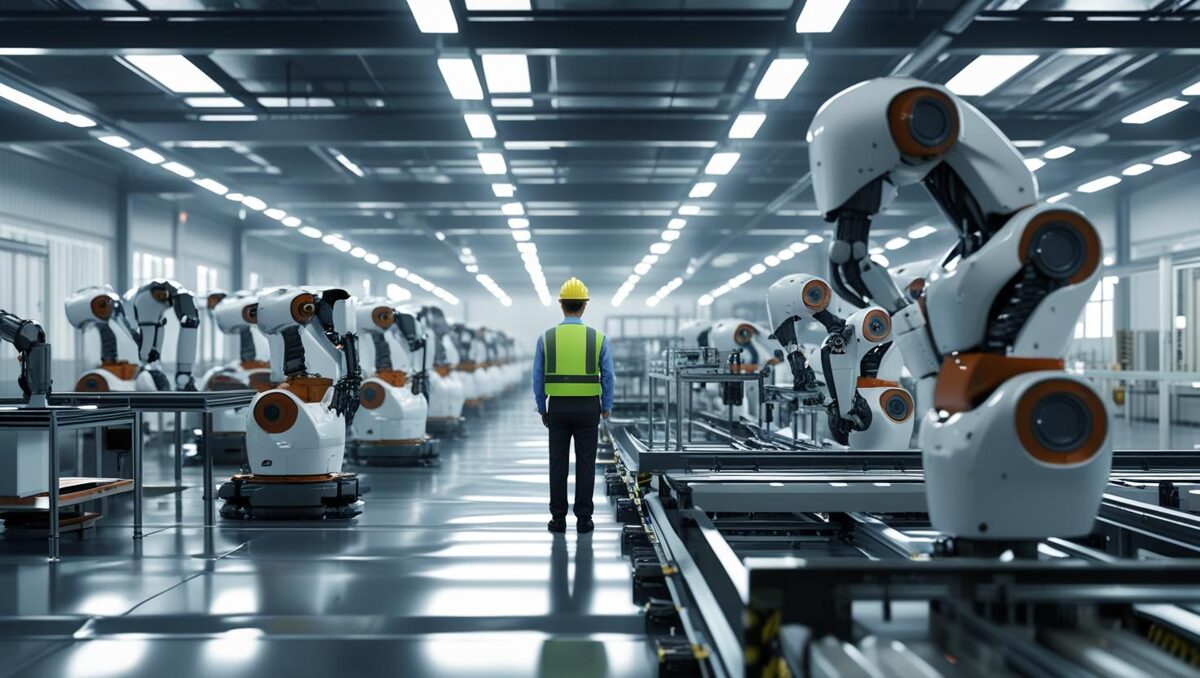
Speculation about a robot revolution may sound like science fiction, but it is a reality among e‑commerce giants. Almost as many robots as humans are already working in Amazon’s warehouses.
The online retailer Amazon has just revealed some interesting information about the operation of its vast global warehouse network. The e‑commerce giant has deployed more than one million robots in its huge warehouses. Amazon claims it has “more than one million employees” worldwide, most of whom work in its warehouse and distribution center network. This means the company is approaching a 1:1 ratio between mechanical workers and those of flesh and blood. At least in Amazon’s case, the legendary “robot revolution,” a decades‑old element of science fiction, is now reality.
Amazon’s robots are more than simple devices for moving goods, such as autonomous forklifts. One of the robots — “Vulcan” — has a “sense of touch” that allows it to carefully pick up various items. These digital warehouse workers were also recently directly connected to the company’s order fulfillment system, thereby increasing efficiency, as people and robots can now work in a complementary way rather than getting in each other’s way.
Reuben Scrivens, research director at the UK robotics consultancy Interact Analysis, explains that Amazon is now “one step closer to achieving full robotics integration.” Amazon’s announcement on the use of robotics states that roughly 75 percent of all deliveries worldwide involve robot assistance at some stage of the process.
Amazon’s growing reliance on automated systems helps address some of its workplace problems, especially the high employee turnover rate in warehouses. It also frees workers from some boring and monotonous tasks, such as moving and sorting packages. Instead, people can be employed in work that requires more skills — for example, operating machines.
Amazon explains that it has trained more than 700,000 employees to “prepare its workforce for the future,” which in this context means working in collaboration with robotic colleagues. It also notes that robotization is made possible by artificial intelligence. The company has released a new “generative AI foundational model” (software that powers many of today’s AI systems, such as ChatGPT) that will increase robot efficiency by 10 percent. Given that Amazon processes 13 million shipments a day, this efficiency gain means huge money.
Why is this news important? It may sound like a description of the internal processes of some huge company that has little to do with small and medium‑sized enterprises.
Amazon is an example for many companies that are automating their workflows, and its wide‑scale deployment of robots is unambiguous proof that this technology is advanced enough — at least in this particular case — for people and robots to work together. This is even more important if we remember that President Trump has declared that manufacturing must return to the US, while experts have pointed out that when this happens, the number of jobs for people will not increase — instead, millions of robots will be employed, which are unlikely to be manufactured in the US. This is also demonstrated by a recent survey of adults who support Trump’s idea but do not want to do physically demanding work in factories.
Amazon’s robots, although intelligent, are only the forerunners of the next phase of robot workers — human‑shaped machines. Research on these humanoids continues at companies such as Tesla and Figure, as the human‑like skills and abilities of such machines allow them to fit into more complex work environments that are already optimized for robots of this size and style. Soon, a cheap, capable humanoid robot may become a logical choice for your business.
! The original article is available on Inc.com. The article was translated with the help of artificial intelligence, but it has been edited by an editor.
Originally published at https://inc-baltics.com/robotu-revolucija-vairs-nav-aiz-kalniem/

Like

Love

Happy

Haha

Sad