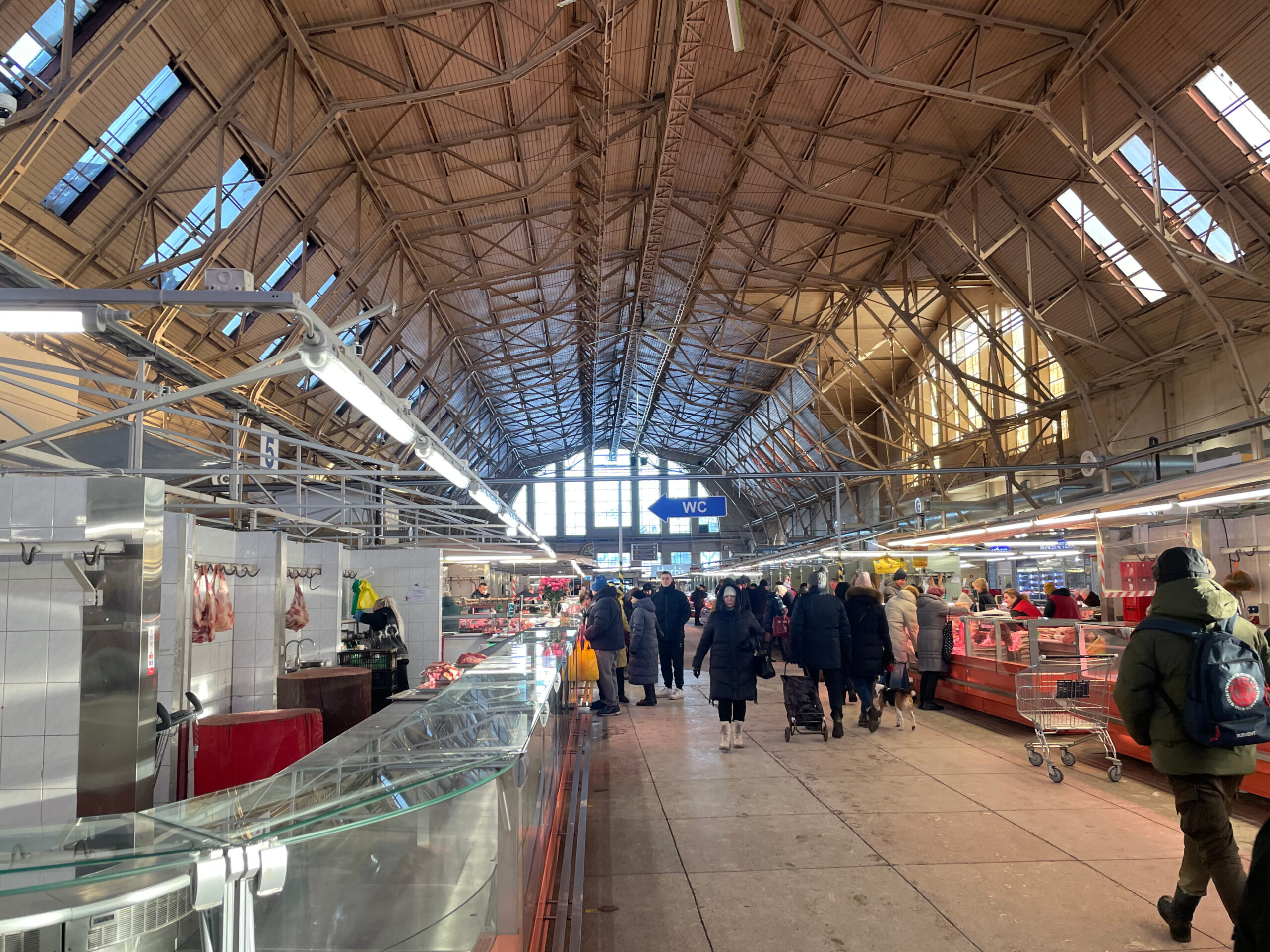
At the beginning of 2026, rental fees have increased for traders at the Riga Central Market, leaving tenants puzzled, Inc. learned at the market. Checking the prices on the market’s website shows that rental fees for different trading spots are rising by different amounts this year, but the largest increase has hit the gastronomy pavilion, where rents are now as much as 79% higher.
The “Rīgas nami” price list shows that price formation differs for various places in the market; for example, in the pavilions tenants pay for display-front meters rather than square meters, and the price may be charged per month excluding utilities, or per day including utilities, with the daily rate also depending on whether a contract is signed or payment is made simply on the same day. In some locations, however, prices are set per square meter. The same applies to the outdoor area and the night market, except that there prices also differ depending on the season.
However, the pricing policy and the mechanism for increasing prices are causing confusion, especially because it is local home producers and growers who may suffer the most.
For example, in the meat pavilion rental fees for all trading places will increase by about 7%, affecting almost all tenants, but for some trading spots the rent will rise by 38%, though only when renting by the day. For other trading places, the increase is the same regardless of whether the rent is paid by the day or by the month.
There are also a number of trading spots where the price formation is not clear at all. For example, in the meat pavilion there are two adjacent trading places, one with an area of 19.9 sq. m, and the other 9.8 sq. m. At the same time, the larger stand has a price of 33.52 euros per square meter per month, while the smaller stand is charged 55.86 euros per square meter per month. In effect, this means that two neighboring places pay a similar monthly amount, but one has twice the area.
Meanwhile, stands around the perimeter of the meat pavilion, where rent is calculated per square meter rather than per display-front meter, will keep their current prices, but those prices differ significantly among themselves, ranging from 27 euros per square meter to as much as 104 euros per square meter per month without any visible reason.
Interestingly, one of the largest price increases will affect storage rooms, which are not a source of income for traders but simply a burden that will most strongly affect product prices themselves. For example, in the meat pavilion the rent for storerooms will rise by as much as 26%, reaching 10 euros per square meter, and this price does not yet include electricity and utilities.
Meanwhile, in the gastronomy pavilion rental prices will rise by 5%, except for home producers, who will have to pay 15% more – both those who rent trading places by the month and those who rent by the day. Traders in the gastronomy pavilion who rent stands and pay per square meter rather than per meter will now have to pay 79% more; among them is also a pharmacy, which will see its rent rise from the previous 55 euros/m2 to 99.48 euros/m2 per month.
In the vegetable pavilion, which during the reconstruction of other pavilions is planned as a “temporary pavilion for rental places” and currently hosts traders of industrial goods, rental prices will rise by 6%. Interestingly, there stands selling goods approved by the market administration or industrial goods have rents ranging from 32 to 52 euros/m2, but traders selling handicrafts must pay 203 euros per month for 1 square meter. Slightly cheaper, “only” 187.87 euros per month for a 1.2 m wide table, is the rate for traders selling self-grown or self-produced agricultural products and honey.
In the fish pavilion the rent for traders will rise by 9%, though not for everyone; for some traders there will be no increase at all. However, fish pavilion tenants will have to pay more for storerooms and washing facilities. For example, the rent for washing facilities will increase by 37% per month, while storage spaces will go up by 14%.
The situation in the night market is particularly interesting. For example, in the flower night market the rent for one night for self-grown flowers, fir branches, wreaths, midsummer grasses, etc., will increase by 19% if a longer contract is signed, but by 39% if the trader pays on the spot each day. However, for those traders who have not grown this produce themselves and who also sell cut flowers, there will be no rent increase at all.
In turn, in the farmers’ night market, during the season (spring–autumn) the rent will rise by 13%, while in winter, the off-season, the increase will be 24%. Thus, if previously the difference between night market rents in season and off-season was 30%, now the price difference has decreased and the in-season/off-season gap is only 23%. Rent has also increased by 40% in the building at Pūpolu iela 5, while the rent for storerooms at Lastādijas iela 1 has risen by 25%.
Inc. interviewed traders who complain that “Rīgas nami”, the manager of the central market, is acting without logic. For example, it is illogical to raise rent for the remaining tenants in the fish and meat pavilions, where no improvements have been made. Moreover, many tenants struggle to pay their rent, and therefore their numbers in the market are shrinking. At the same time, product prices are rising, and shopping at the market is no longer particularly advantageous compared with large retail chains. Instead of lowering rents to attract more tenants and thus more customers, the market is raising rental prices.
Meanwhile, “Rīgas nami” does not deny that this is exactly the plan – to raise rents for existing tenants in order to finance investments in other pavilions. “The task of the Riga Central Market administrator is to ensure both that traders’ interests are respected and that the Riga Central Market is well managed, with developed, maintained infrastructure and safety. To achieve these goals, the pricing policy must be periodically reviewed. The price list that entered into force in 2026 was prepared using a cost-calculation method, taking into account several factors: the technical condition of each pavilion and its actual maintenance costs, the necessary investments for its upkeep, the location of the trading place, as well as seasonality. The aim of adjusting rental fees is to ensure sustainable maintenance of the market infrastructure and its gradual improvement,” says “Rīgas nami” public relations specialist Jānis Bunte.
He explained that, within the framework of implementing the Riga Central Market development concept, the market’s pavilions are currently being renovated in sequence, with temporary relocation to ensure continuity of market operations, develop new functions and at the same time preserve the unique cultural and historical heritage. The market development concept provides that by 2029 all market pavilions must be renovated and appropriately fitted out, concentrating trading functions in four pavilions. This means not only visual changes in the interior, but also reinforcement of almost hundred-year-old structures, replacement of the roof covering, renovation of basement floors and other work that is not visible to market visitors.
“As the market administrator, “Rīgas nami” has a clear vision for the further business development of the market, and it is closely linked to the aforementioned Riga Central Market development concept. The existing market model must be adapted to modern conditions, preserving the trading function and concentrating it, as well as introducing new functions and services. Therefore, the market management plan for the coming years is not a simple increase or decrease in rental fees, but a set of complex measures to ensure that the market is full of vibrant activity. In our view, attracting buyers and increasing the number of traders is to be achieved mainly by improving the market’s offer rather than just through pricing policy. Visitor flows to the market would be increased not only by improvements to trading places in the pavilions and outdoor areas, but also by upgrading green areas and squares, creating a pedestrian shopping street on Spīķeru iela, offering modern office space for rent in the market territory, and “reviving” the market outside working hours with cultural, artistic and entertainment events, etc.,” writes Bunte.
Originally published at https://inc-baltics.com/rigas-centraltirgu-nomas-maksa-pieaugusi-lidz-pat-80-visvairak-cietis-majrazotaji-un-vietejie-audzetaji-produktu-cenu-pieaugums-sekos/

Like

Love

Happy

Haha

Sad