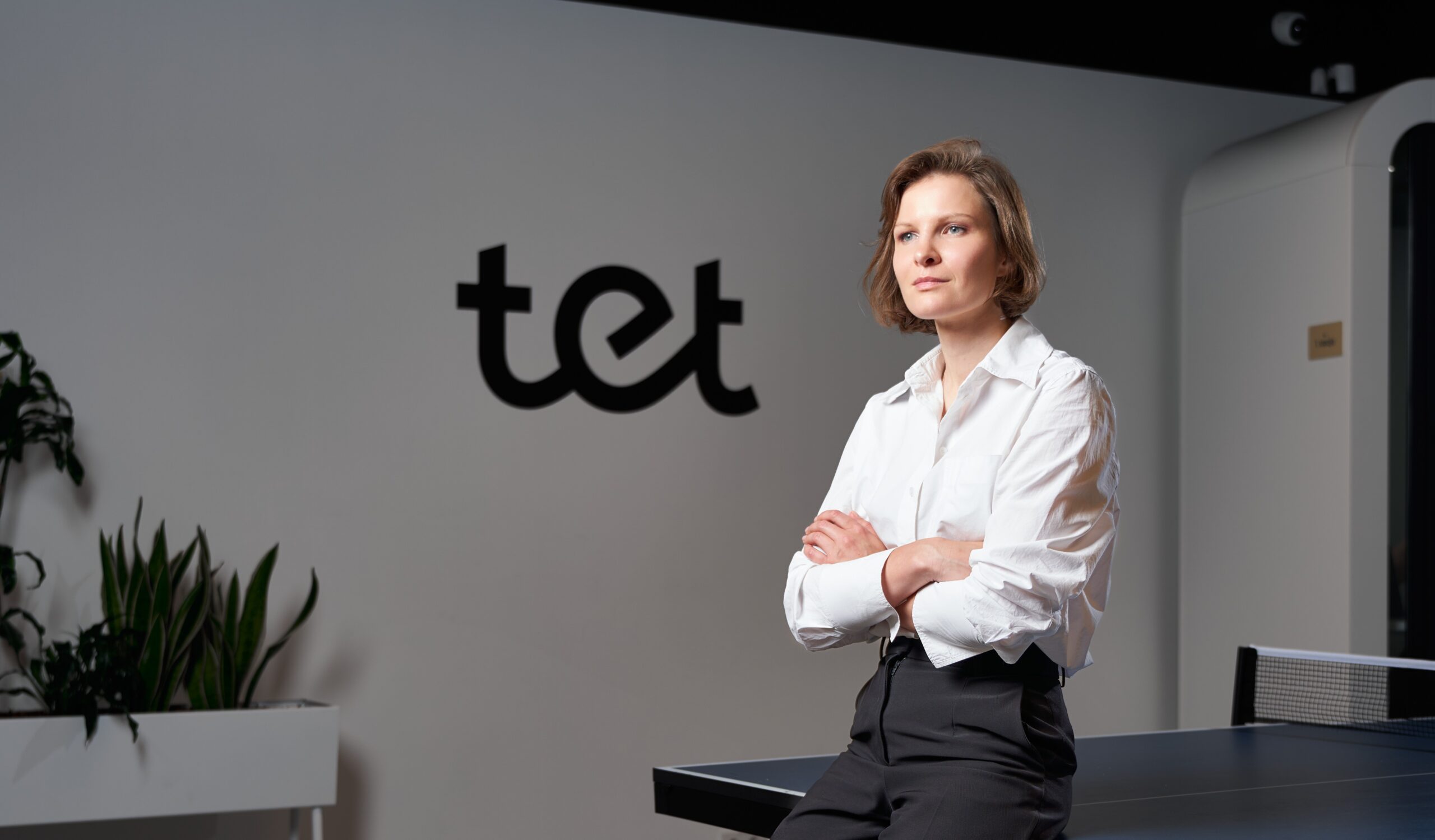
In the field of research and development (R&D), small and medium-sized companies in Latvia invest only when all other needs are already covered and there is money left over. Yet R&D is in fact the very foundation that allows us to explore and introduce previously unseen services and products. Working with scientists is often something only large and wealthy companies can afford. Guna Soloveja heads the R&D department at one of the large international telecommunications companies – Tet – and explained why we won’t get far without science.
Tell us what you do in the company and how it relates to research?
I am the head of Tet’s research and business growth department – I lead the processes related to the development of innovation projects and take them through to new products and services. In practice, we research global markets, write shorter and longer projects, attract local and global cooperation partners, and also work with scientists and support funding at the international level.
Doesn’t that come from the company’s own funds?
Partly. Projects in any case need co-financing, and the source of funding also depends on the field in which the project is planned. For example, in innovations with a lower level of technological maturity, where extensive research and cooperation with academic institutions and scientists is needed, the support intensity from the European Union (EU) is higher – it can reach up to 100%. For instance, projects under the “Horizon Europe” programme, which is one of the highest levels, but to get into it you need a very good international team.
Meanwhile, in projects aimed at developing local or cross‑border infrastructure, EU support is lower. For example, a current project is 5G-BALTICS – a 5G infrastructure corridor along the Via Baltica motorway from Tallinn to the Lithuanian–Polish border. There, EU support is 50%.
The projects that are closer to our own market and core business are more financed from our own funds, because then we immediately know how and when we will recover the investment, so we can afford it.
What are these development projects mainly like? Is it infrastructure, or add‑ons and modernization of existing services, or something completely new? One is 5G, but what else?
The Via Baltica project mentioned is part of the European infrastructure development instrument, which supports both these 5G corridors and also the digitalization of energy and transport. Then there is a completely separate area – data centers and increasing computing power. Currently one of Tet’s development priorities is related to artificial intelligence. To run AI models (artificial intelligence, AI – mākslīgais intelekts, MI), we need appropriate computing power; otherwise they won’t work.
We can talk a lot about how we will implement something and everything will happen, everything will be automated, but if there is no infrastructure behind it, all plans become impossible. This means that we must simultaneously develop suitable infrastructure so that the AI and other innovations created can operate.
We also have the cybersecurity direction – we are currently living in the conditions of hybrid warfare. We receive a lot of cyberattacks, and it is good that most of us know and suspect nothing about them. This means that CERT.lv, we – Tet – and other security service providers are doing a good job. However, attacks are becoming more and more complex. This means that we must also be able to create more complex and already automated cybersecurity solutions.
About cybersecurity. Recently, everything “crashed” at Aeroflot, and this morning before the interview your website was down for several hours… From time to time seemingly impossible things happen. What does cybersecurity include nowadays?
The cybersecurity of large companies and public‑sector institutions is based on very complex systems, it is like a whole orchestra that has to operate on various devices – computers, phones, etc. Usually this monitoring takes place in security operations centers through which this information flows, and the main task is to be able to track it and prevent unwanted activities.
The first step to understanding where and how one can attack is vulnerability scanning, a cybersecurity audit has to be carried out. This shows what vulnerabilities can arise and in which systems. Next, one has to understand what the attackers are interested in: getting money, accessing valuable company data? Carrying out a DDoS attack, or perhaps something else? And then there are attacks targeting people, such as phishing, which is currently one of the most popular types of attacks. The potential field of cyber risks is very broad.
Once everything is identified, attacks can be categorized from the perspective of the security operations center and conclusions can be drawn about what happened and how to respond. But in order to be able to repel future attacks more successfully and quickly, it is very important to understand who attacked, why they attacked and how we can pre‑emptively prepare our systems and employees.
How many Tet employees are responsible for the security segment in the company? Your previous answer sounded very large‑scale.
I won’t name a specific number. In Tet’s case, it is a compact, very high‑level cybersecurity team with exclusive international certifications, whose responsibility is, of course, enormous.
You lead the whole R&D department, but how do you navigate and talk about so many highly specific things without the corresponding education and experience – at least I didn’t see that in your CV? Do you study somewhere specifically, or is it more project management, management? It could be difficult to manage something that is not fully clear.
I certainly don’t know everything, but I know the specific areas from a business development perspective and I observe needs and demand both in the country and in Europe. Various Tet experts come to our department’s aid; they work in teams on specific projects. I like the theory of “T‑shaped” teams. There are people who oversee things horizontally, and then there are the necessary experts who go deep – vertically – in their field. A quality result is only possible when both can work together.
My role is that “horizontal” one – to connect the entire ecosystem. I have experience working with the research sector; I have worked with scientists. One of the biggest challenges of the academic sector, for example, is that if researchers are deeply immersed in their topic, it can be very difficult to see real‑world applications and commercialization opportunities. If a team consists only of experts who each go very deep into their own topic, that can hinder business development.

Let’s get back to R&D. What are the TOP 3 projects currently on your agenda?
Critical digital infrastructure projects, including the aforementioned 5G-BALTICS.
By digital infrastructure we mean the fiber‑optic internet network needed to ensure service continuity for the civil and defence sectors, as well as data centers, which have become part of the critical digital infrastructure ecosystem.
The second priority area is cybersecurity – automation of cybersecurity functionality, building up cybersecurity capabilities, human resources, training, development, and everything cybersecurity needs at present and will need in the next two to five years, and that is quantum‑safe technologies. We already see a trend in cyberattacks where attackers try to collect data now, but decrypt it later. They set themselves the goal of accumulating valuable sensitive data that can later be decrypted with quantum technologies and used for manipulation. That is why Tet is currently working on quantum‑safe technologies. And the third priority is the automation of business processes, various automation solutions with the help of AI. You don’t always need AI agents or very large AI models; sometimes they can simply be automation projects that are still the story of good old digitalization and digital transformation.
We’ve already been hearing about that for as long as I can remember.
Yes, it’s an old term, but if digitalization processes are not in order, it is very difficult to apply AI models.
There are systems that work well, but there are those where a lot of things have been historically patched together. In those, of course, you won’t be able to automate everything. At the same time, the problem is not always in technology, but also in various collaboration processes.
Tell us more about the 5G-BALTICS project. What is it?
At the moment, it is one of our largest infrastructure projects. 5G-BALTICS is the construction of a 5G corridor along the Via Baltica road. It is a cooperation project between the three Baltic states, led by Tallinn University of Technology – a great example of how telecom operators in all three countries can finally cooperate. The main test at the end of the project will be the ability of a self‑driving car to travel through the whole corridor from Tallinn via Riga to the Lithuanian–Polish border. That will be an indicator that data availability really works.
We are providing the Latvian section from border to border in cooperation with Tele2. It is important to understand that a 5G corridor does not appear simply by putting up some base station or tower. All infrastructure elements need to be connected to each other and to existing telecommunications: the fiber‑optic network that can provide a sufficiently fast and stable internet connection for 5G stations to work. Only by interconnecting all network elements will the corridor work; individually – it won’t. Another challenge is also the cross‑border section – it is necessary to solve how everything will work when crossing the border where there are other operators and other suppliers.
What is it that you will eventually sell to clients – companies, individuals – from this project?
Once this 5G corridor is built, the end user, the population, will get access to 5G coverage along the entire line – in practical terms that would mean the possibility to take part in a Teams meeting along the entire route without interruptions. It sounds simple, but the experience of Ukraine shows that this is not the case at all, and such critical infrastructure is extremely important. For example, in Ukraine this infrastructure is being developed specifically along railway lines because when there are attacks, all business is conducted on the train, so data availability is crucial.
Do we have that? Is there still somewhere that doesn’t? Is internet coverage really still considered something particularly modern? What will come after 5G?
At the 5G Techritory forum they are already talking about 6G, although I won’t be able to explain all the nuances. At the moment 5G is still relevant and very important, especially for maintaining various smart city solutions where there are many elements and various sensors. 5G “islands” are also being built that are intended for special operations, including in the defence field.
I would say that things are going well for us in Latvia. But again, the same story – in some large countries where the basic infrastructure and fiber‑optic network are not in order, it is even more difficult to develop advanced 5G technologies. For example, in a large country like Germany, there are regions where coverage is lacking.
You mentioned Tallinn University of Technology as the lead of a particular project. What other organizations do you cooperate with? Where do you look for scientists?
Each thematic area has its own community – whether it is cybersecurity or quantum technologies, or critical infrastructure, or network infrastructure. We cooperate a lot with Riga Technical University and the University of Latvia’s Institute of Mathematics and Computer Science. Latvia also has significant advantages in quantum technologies because we have brilliant researchers known throughout Europe – Professor Andris Ambainis, Professor Vjačeslavs Kaščejevs. What they have achieved and discovered in this science gives Latvia a good springboard to position itself in international cooperation.
Of course, we cooperate with the academic sector in other countries as well, most often with our closest neighbours – Estonians, Finns, Lithuanians, Czechs, Poles, Norwegians, Ukrainians, etc. With the Finns, we have quite a few projects in the data center direction; this area is highly developed there, as it is in Poland. Poland and Finland are two countries that are also working further on quantum computer development; similarly, their data center and computing direction is at a very high level. Estonia’s strength is cybersecurity at all levels – in state institutions, specialized companies, and the academic sector.
Can we say that these are partners who are one step ahead, rather than some new scientists or startup companies?
The ones mentioned – yes. But it is advantageous for us if we see scientific or research developments and can adapt them here, bring this knowledge and applications to Latvia.
Why? Isn’t it the case that young scientists are creating something, not fully understanding what will come out of it, and you invest without knowing what the end result will be?
Often they are not that young. The knowledge base they have, what they have already figured out, cannot be quickly acquired in our business environment. We have to be fast and do not have the opportunity to carry out in‑depth research the way scientists do. That is why it is valuable for us to work with the academic sector in order to understand the scientific developments that we can bring to market today already. This way we can arrive at new niche products and services to offer in international markets. By combining Tet’s existing expertise and knowledge with unique findings, we achieve success in export markets.
Do the cooperation projects you mentioned also export, or are they mainly joint developments?
Export is a separate area; we have been exporting for over a dozen years. For example, we have been in Ukraine with our data center business for 12 years, and we are doing very well there. Precisely within the framework of various cooperation, exports account for 18% of Tet’s turnover.
We cannot just sit here and think that, without knowledge of what is happening abroad, we will be able to create something exportable, which is why we create new products together with international partners, but they are still primarily based on our core business and the areas where we see development in three to five years.
Thus, through development projects we look for exportable niches, reduce business risks and bring international competences to Latvia.
You mentioned Ukraine, which doesn’t really sound like risk reduction. In the context of the war, what is there in Ukraine that we don’t have in Latvia? What have they learned to do differently because of the war – what are the take‑aways we can learn from them?
Without a doubt – speed. If a solution is needed, it is needed now and immediately. Their speed of adaptation, learning, and decision‑making is phenomenal. In Latvia we still can’t do that; we want to discuss and think it over. Colleagues at Tet who work with Ukrainian business have a completely different pace. In 2022, our data center colleagues had to react very quickly – within three months we helped 50 Ukrainian clients protect their data by migrating it to our partner data center in Frankfurt. Even now, it is very important for our Ukrainian clients that their data can be stored in certified data centers in Europe.
Speaking of progress, you mentioned that you are looking at trends and where the world is going. When something big needs to be developed, but resources are, as we know, not unlimited, how do you plan and understand things so that you haven’t missed the boat by the time you finish researching?
We have different types of development. There are short development projects, for example, for new services. Short – that means three to 12 months. During this time, we can understand whether we will bring the service to market or not. Most often these are solutions already developed and working in the world, which we adapt to the local market.
The second segment is innovation projects that we deliberately develop for several years. They are linked to our core competences. These areas do not become obsolete quickly, so we return to them again and again. I am increasingly skeptical of “Silicon Valley presentation‑type” innovations because, to really implement innovations, you have to build up competence over several years and go through various research and development cycles. Thus, it does not matter whether in the research process we go a little more to the right or to the left, because the basic expertise and strategic direction remain.
We know anyway that cybersecurity is a major trend worldwide and in our region, so no matter how fast or slow we succeed in this area, we will not abandon it. The same goes for all the necessary critical digital infrastructure and its resilience.
As for artificial intelligence – it seems that it flashed into view quickly in 2022, but in fact we are already in one of its later generations. Tet has been working with big data and various types of automation for more than 10 years and trained its first models manually. This means that we have the competence to be able to quickly orient ourselves and know how to apply generative AI now that it has appeared.
But there are technologies and services that gradually decline. For example, landline phone lines are slowly disappearing with smartphones, but that doesn’t happen overnight either.
Are there any products and services that have proven themselves somewhere and seem very good, but that are not successful in Latvia or the Baltics? Or is technology development such a global process that sooner or later all regions go through the same things?
Solutions don’t catch on where, as a society, we are not sufficiently solvent or where we see them as secondary needs.
What always needs to be kept in mind – we cannot afford to think only in terms of the Latvian market; we understand that the internet has become a basic necessity – like utilities – therefore, if we want to develop higher‑value services, it is smarter to work by pooling competences and exporting them to the wider world.

You said Tet has been in the AI field for more than 10 years. How much are AI solutions currently integrated into Tet’s products and services? And what about security in the AI field? There are all kinds of regulations and concerns about data.
We have gone through several stages, starting with the chatbot Anete. For several years we have been using AI solutions in customer care automation to improve the quality of customer care. AI helps to analyze data on how successfully we are able to serve customers, what words customers react to during a conversation.
We have implemented our internal Tet GPT solution so that our employees can work safely with Tet data, process internal documents without sending this information outside, as would be the case if employees used open versions of ChatGPT. It is important that employees use closed, protected GPT environments, so our data does not end up in the hands of OpenAI and we can protect trade secrets.
We have an AI department with a team of data scientists. They not only train AI models and implement them for various automations but also conduct various training sessions for colleagues and introduce them to the latest global AI trends.
In the television field, AI solutions are used for subtitling, translation, and dubbing. Automated subtitling will be on the market very soon; we see that doing these things manually is much more expensive, and the same goes for translation.
Currently, Tet also has two projects for the development of AI assistants and models for the automation of medical and healthcare processes, which we are implementing in cooperation with Latvian medical institutions. We have gone through quite a long road with the medical sector to understand how to protect sensitive medical and personal data as required by GDPR and the European artificial intelligence act, while at the same time carefully training AI models tailored specifically to the medical field.
Let’s talk about challenges. What do you see coming in the next five years?
I’m not a clairvoyant, but what will not change is the need to bring together technology trends and people’s feelings. For example, the general emotional background in our region is and will remain linked to geopolitics and various hybrid and security threats – this is what we have to work on.
The second thing is EU regulations – they are not going anywhere, so business must be able to adapt. In the age of AI and hybrid attacks, there will be more and more acts and rules that protect the rights of EU citizens, and that is how it should be. In business, the most successful will be those who are able to process these rules and adapt to them. Latvia, as a full member of the EU, has committed itself to complying with them. The third challenge is attracting qualified labour, especially in security fields.
And finally, talking about AI development – it will not stop; the development of models and agents will continue. At Tet, we have set the goal of being the regional flagships in the field of AI infrastructure and applications.
Do you have the feeling that we will be those AI flagships?
We can – definitely. We have the potential.
This interview was published in the first issue of Inc. Latvija magazine in October 2025.
Originally published at https://inc-baltics.com/mes-varam-but-maksliga-intelekta-flagmani/

Like

Love

Happy

Haha

Sad