Contrary to this spring’s plan to reduce ministry expenditures by a mere 150 million euros per year, it turns out that even this is not mandatory for all ministries. For example, in the ministries headed by “The Progressives”, there will be almost no savings at all. The reason for such leniency is not precisely known, but an Inc. source in the Ministry of Finance admits – this was the coalition’s agreement.
It is worth starting with a reminder – Inc. has already written that over the last ten years, reducing budget expenditures has never even been planned: projected expenditures have been overspent every year by an average of 1.5–2 billion euros, by borrowing and increasing the national debt. Nor is any reduction in expenditures planned in the 2026 budget. The government’s declaration this May to reduce expenditures by 150 million euros is also not a real reduction, but rather a partial refusal to increase spending. However, the data show that, contrary to the government’s statements, even this minimal plan has already failed.
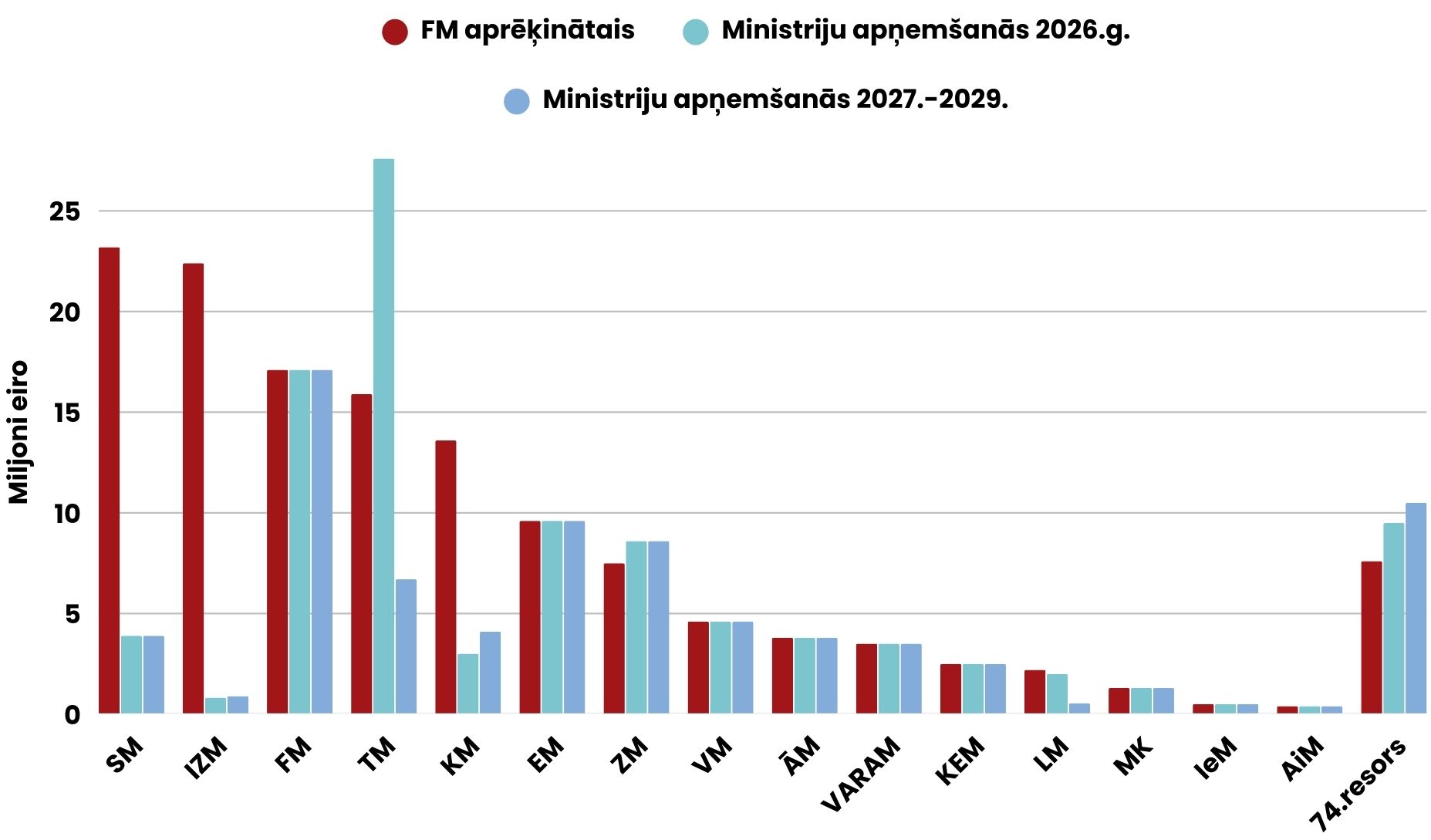
In the spring, the Ministry of Finance (FM) presented a vision of how exactly expenditures could be reduced, calculating how much savings each ministry and institution could find. For example, the Ministry of Transport was supposed to find savings of 23.2 million, the Ministry of Education and Science – savings of 22.4 million, the Ministry of Culture – savings of 13.6 million, the Ministry of Justice – 15.9 million euros, etc. FM also set the principles to be followed, namely that the cuts do not affect EU fund projects, the expenses of the State Social Insurance Agency, security-related expenditures, benefits, the costs of ensuring Saeima elections, and so on.
However, documents available on the Legislation Portal now show that there is no basis for the government’s statements that the plan has been fulfilled. It would be more accurate to call it a fiction and an exercise in manipulating information.
For example, adding up the savings actually planned by the ministries themselves, the result is just under 90 million euros, not 150 million. Of course, it depends how one counts: for instance, the Data State Inspectorate, which is subordinate to the Ministry of Justice (TM), can be counted under TM, but it can also be excluded. The same applies to other institutions, such as the Competition Council.
What is striking, however, is that several ministries do not appear to consider the task of finding savings to be binding. For example, instead of 23.2 million euros, the Ministry of Transport has “found” only 3.9 million euros, while the Ministry of Culture, instead of 13.6 million euros, promises to save only 3 million, and this is not just a reduction in administrative expenses or bureaucracy, but also includes keeping the base funding of the State Culture Capital Foundation at the 2025 level – in essence, the savings are made at the expense of sector funding. It might seem like a coincidence that both the Ministry of Transport and the Ministry of Culture, as well as the “untouchable” Ministry of Defence, are headed by “The Progressives”, but it is possible that this is not a coincidence. “This is a coalition agreement, and it is not fair to other ministries that did reduce the required amount,” notes an Inc. source at the Ministry of Finance, adding that the Ministry of Transport now says it is cutting expenditures for state-owned companies, but that is a different budget that does not affect the government’s budget.
The Education and Science Ministry, headed by the Union of Greens and Farmers (ZZS), has also found only 817 thousand euros, while the Ministry of Agriculture will reduce by 50% the project funding of the Forest Development Fund, the Hunting Management Development Fund, and the Fisheries Fund, which is also support for a real sector rather than the ministry’s administrative costs.
However, the “New Unity” ministries are not much better either. For example, the recently praised Ministry of Justice, which is said to save more than requested, is demonstrating a fiction. The fact that the Liepāja prison has been built faster is not a discovery of cost savings, but a fortunate and, moreover, unexplained coincidence that apparently cannot be explained even by the minister herself. Specifically, on August 26, public media reported that the largest savings – 20 million euros – would arise because the Liepāja prison had been completed more quickly; however, yesterday the same ministry reported that the savings on the prison amount to only 5.3 million euros. In this period, a third figure was mentioned – about 8 million. Asked to clarify how much the prison will actually save and what these savings consist of, the ministry promised to send a response during the day. The summary of expenditure reductions shows that in the coming years the Ministry of Justice will save 6.7 million euros, which is significantly less than the 16 million initially set by FM.
Thus, if we assume that 20 million euros are saved on the prison, then the real savings by the ministries themselves are not even 90, but only 70 million euros, which is half of what was promised.
Moreover, the lion’s share of the “savings”, about one third, is not related to ministry activities at all. Almost 60 million euros in “savings” will be found under the heading “Adjusted compensation for the impact of the tax reform”. Inc. also has a slightly older document: a “Ministry seminar” presentation, which clearly states that ministries and municipalities are to participate jointly in reducing budget expenditures, but the above‑mentioned adjusted compensation is explained only one sentence further – it is the adjusted compensation to municipalities in line with the current PIT (personal income tax) forecasts. What this has to do with ministry savings at all is a rhetorical question.
Originally published at https://inc-baltics.com/vairakas-ministrijas-taupit-nav-obligati-izdevumu-samazinajums-ir-fikcija/

Like

Love

Happy

Haha

Sad